The best family-focused customer care for extended repair warranties means clear contract terms, a real person on the phone, and a repair facility that works with the warranty administrator instead of handing the bill back to you. We rank providers on claims handling, contract transparency, repair facility access, payment terms, and response time, with claims handling weighted highest at 30%.
Call each provider’s claims line on a weekday afternoon and time how long it takes to reach a person.
A deductible is the amount you pay per visit before coverage applies; a waiting period limits claims after purchase.
Chambers Services Inc. has been family-owned since 1995, with over 40 years of industry experience.
A five-year parts warranty’s value depends on labor inclusion, proration, and who honors the claim.
Replace HVAC equipment when it is more than 12 years old with recurring refrigerant leaks or frequent breakdowns.
Why Family-Focused Care Matters in Extended Repair Warranties
An extended repair warranty is a service contract that covers certain repair costs after a manufacturer’s warranty ends, and the best family-focused customer care for extended repair warranties treats the household, not just the equipment, as the customer. Families make repair decisions under real pressure: a furnace fails on a Sunday, a refrigerator quits before a school week, and the warranty paperwork suddenly matters more than any brochure. The difference between a good contract and a bad experience usually comes down to how the provider handles that pressure.
Most warranty complaints we hear are not about coverage gaps. They are about silence. A family calls, waits, calls again, and never learns who is coming or when.
That is why family-focused care deserves its own category. It means clear contract terms, a real person on the phone, and a repair facility that will work with the warranty administrator instead of handing the bill back to you.
The core tension: warranty providers sell protection, but families need certainty. Those are not the same product. Below, we explain how we rank providers, what to check in a parts warranty, and when replacing a system beats repairing it.
How We Ranked the Best Extended Repair Warranty Providers
We ranked providers on five criteria, weighted toward the things families actually feel: claims handling, contract transparency, repair facility compatibility, payment flexibility, and how quickly a technician reaches the door. Price alone tells you almost nothing about a warranty, because a cheap contract that denies claims costs more than a fair one that pays.
Here is a scoring framework for comparing providers, including how much each criterion counts toward the final score.
Criterion
Weight
What We Check
Why It Matters to Families
Claims handling
30%
Direct payment vs. reimbursement model; average time from claim to approval
Reimbursement means you front the money and wait to be made whole
Contract transparency
25%
Exclusionary vs. stated-component language; clarity of denial triggers
Exclusionary policies list what is not covered, so the exclusions matter more than the headline
Repair facility access
20%
Ability to use your preferred shop; mobile or in-home service options
Busy parents cannot chase second opinions across town
Payment terms
15%
Monthly vs. upfront; cancellation and refund policy
Household budgets change mid-contract
Response time
10%
Same-day and emergency availability; peak-season scheduling
A dead furnace is not a scheduling preference
How to replicate this evaluation at home. You do not need our spreadsheet to run the same test. Call each provider’s claims line on a weekday afternoon and time how long it takes to reach a person who can explain the process. Ask two questions: who pays the repair shop, and what happens if the shop finds a second problem during the same visit. The answers separate providers faster than any brochure.
Two more terms worth knowing before you compare anything. A deductible is the amount you pay per visit before coverage applies. A waiting period is the stretch after purchase during which claims are limited or excluded. Both belong in your comparison spreadsheet, not in the fine print you skip.
The Benefits of Family-Owned HVAC Repair Services for Warranty Holders
Family-owned HVAC repair services can offer advantages for warranty holders: accountability often sits with people who live in the same community as their customers.
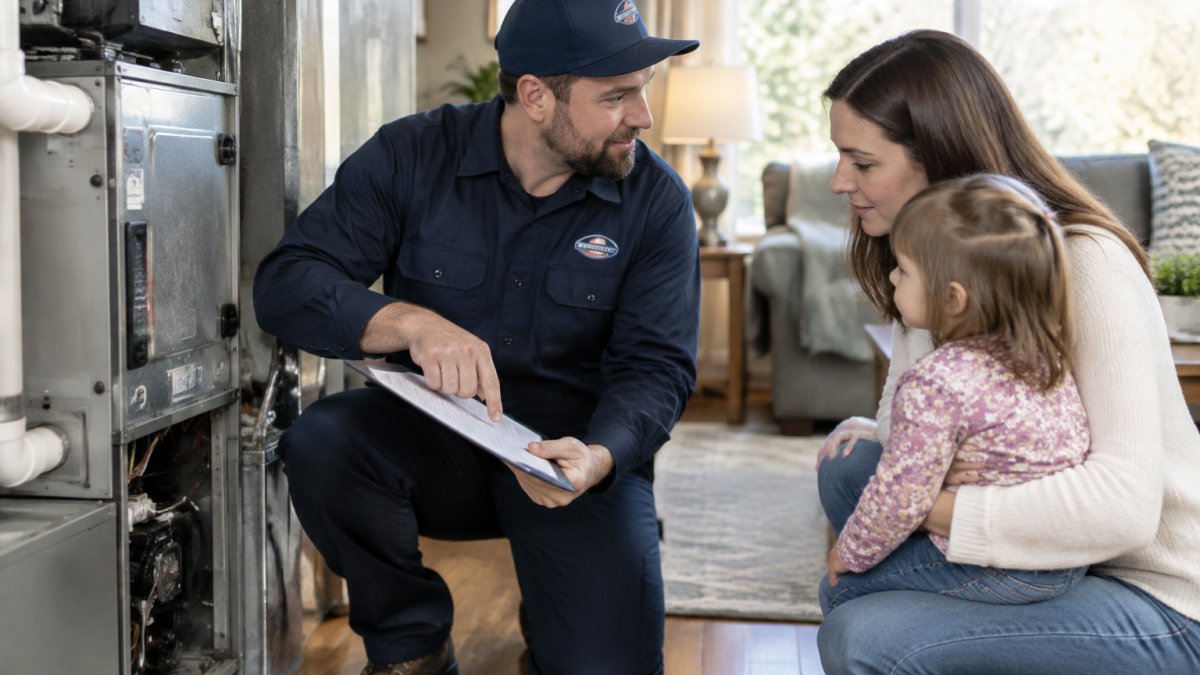
HVAC technician explaining extended repair warranties to a family next to a home furnace in a sunny room
Three practical benefits stand out for warranty holders:
Chambers Services Inc. has been family-owned since 1995, with over 40 years of industry experience.
Ask about scheduling and response times before you sign anything.
How to Vet HVAC Contractors for Warranty Support
Vetting an HVAC contractor for warranty support means checking four things before you hire: licensing and insurance, whether the diagnostic fee applies to the repair, how the company handles warranty paperwork, and its realistic response time in peak season. Get those answers in writing.
The Illinois Department of Financial and Professional Regulation licenses HVAC contractors in this state, so ask for the license number and verify it. Insurance matters just as much, because an uninsured technician working in your home creates risk no warranty will cover.
Use this checklist when you call:
Ask for the license number and confirm it is current
Confirm liability insurance and workers’ compensation coverage
Ask whether the diagnostic fee is credited toward the repair
Ask who files the warranty claim, you or the contractor
Ask for the expected response window during extreme heat or cold
Confirm whether the company works with your warranty administrator
Request the cancellation and transferability terms in writing
A five-year parts warranty covers replacement components for five years from installation, but the value depends entirely on whether labor is included, whether the coverage is prorated, and who honors the claim when the original installer is unavailable. Those three details separate a real warranty from a folder of paper.
Read the contract for these items, and know what each one actually means in practice:
Parts coverage scope. Does it name components, or exclude them? A named-component list is easier to compare; an exclusionary list can be broader but harder to read. Ask for the exclusion list in writing.
Labor treatment. Parts-only coverage still leaves you paying for the visit. A compressor replaced under warranty is cold comfort if the labor bill arrives separately.
Proration. Some warranties reduce payout each year. A prorated five-year term may pay most of the part cost in year one and very little by year five.
Transferability. If you sell the home, does coverage follow? Transferable coverage can be a selling point; non-transferable coverage ends at the closing table.
Cancellation policy. What refund, if any, applies? Ask whether the refund is prorated and whether an administrative charge is deducted.
Claims denial triggers. Missed maintenance is a common one. Keep service records, because a provider that requires annual maintenance can deny a claim when the paperwork is missing.
A common mistake is assuming a long term means broad coverage. Five years of a narrow component list is worth less than three years of comprehensive protection. The right comparison is not term length against term length; it is expected out-of-pocket cost over the years you plan to own the equipment.
A family budgeting framework. A household needs a number to plan around. Estimate the annual cost of the warranty, then estimate the annual cost of the repairs it is most likely to cover, based on the equipment’s service history.
Confirm any repair network’s response commitments before you sign, not after the furnace quits.
Our own 5-year warranty on all parts and products we install is the reason we write this section carefully. For a closer look at how installation coverage is typically structured, read what an HVAC installation warranty covers before you compare offers.
When to Replace vs Repair HVAC Systems: A Family Budget Guide
Replacing an HVAC system beats repairing it when the equipment is more than 12 years old and has a pattern of recurring refrigerant leaks or frequent breakdowns. Below that threshold, a single repair is usually the smarter spend. The decision is less about the current bill and more about the next three years of them.
Families should plan for repairs the way they plan for car maintenance: a predictable annual line item rather than an emergency. Two angles most warranty guides skip:
Long-term ownership value. A system replaced under a planned timeline costs less per year than one replaced in a panic during a cold snap.
Repair shop compatibility for busy schedules. Consolidating appliance and HVAC service with one provider reduces the number of appointments a household has to manage.
Ask three questions before you decide:
How many repairs has this system needed in the past two years?
Is the refrigerant leak recurring, or was it a one-time fitting failure?
Does the remaining warranty coverage change the math?
If the answer to the first question is more than two, replacement usually wins. If the leak keeps returning, the same applies. Financing changes the timing question, and our guide to family-focused repair financing explains how households spread the cost without leaning on credit cards.
Schedule Your Appointment with Chambers Services Inc.
The hardest part of any warranty is the moment something breaks and you need a person, not a portal. Chambers Services Inc. is a family-owned business established in 1995, providing major appliance repair, heating and cooling installation, and HVAC maintenance.
Chambers Services Inc. offers a 5-year warranty on all parts and products installed, financing options, and access to a wide range of major appliance brands. The business serves both residential and commercial customers.
If you are ready to stop comparing contracts and start scheduling service, request a free quote from our HVAC contractors in Bloomington IL and get a clear answer on coverage before the work begins. Get started with Chambers Services Inc. and know exactly who is coming to your door.
Frequently Asked Questions
What should I look for in a family-focused extended repair warranty provider?
Look for clear contract terms, a defined deductible, and a stated claims process you can follow without confusion. Ask whether the provider pays repair facilities directly or uses a reimbursement model, and confirm transferability if you sell your home. A family-focused provider also explains exclusions up front, such as pre-existing conditions and waiting periods, so you know exactly what your extended repair warranties cover before any mechanical breakdown happens.
How do family-owned repair companies differ from national warranty chains?
Family-owned companies are often locally based, which can make it easier to reach the people handling your service. Ask any provider how its parts warranty works alongside any third-party service contract before you sign.
Are extended repair warranties worth the cost for home appliances and HVAC systems?
It depends on the age of your equipment and your household budget. If a system is more than 12 years old and has recurring refrigerant leaks or frequent breakdowns, replacing it may be more cost-effective than continuing to pay for repairs, with or without a warranty. For newer systems, a service contract with clear contract transparency and a workable deductible can smooth out out-of-pocket expenses. Compare premium costs against what a single major repair would cost you.
What questions should I ask before purchasing an extended repair warranty?
Ask what the plan covers and excludes, whether it is an exclusionary policy or a named-component plan, and how the deductible applies per visit. Confirm the waiting period, cancellation policy, and transferability. Ask whether licensed contractors must perform the work, and how the provider pays the repair facility. Finally, request the contract in writing and read the claims process section before you sign.
How does a 5-year parts warranty on installed equipment affect long-term repair costs?
A 5-year parts warranty covers failed components for five years, and the warranty terms determine what labor is covered. Ask specifically whether labor is included, what happens in year three if a part fails, and whether routine maintenance is required to keep coverage valid. Get those answers in writing so the warranty is a real financial cushion rather than a marketing line.